

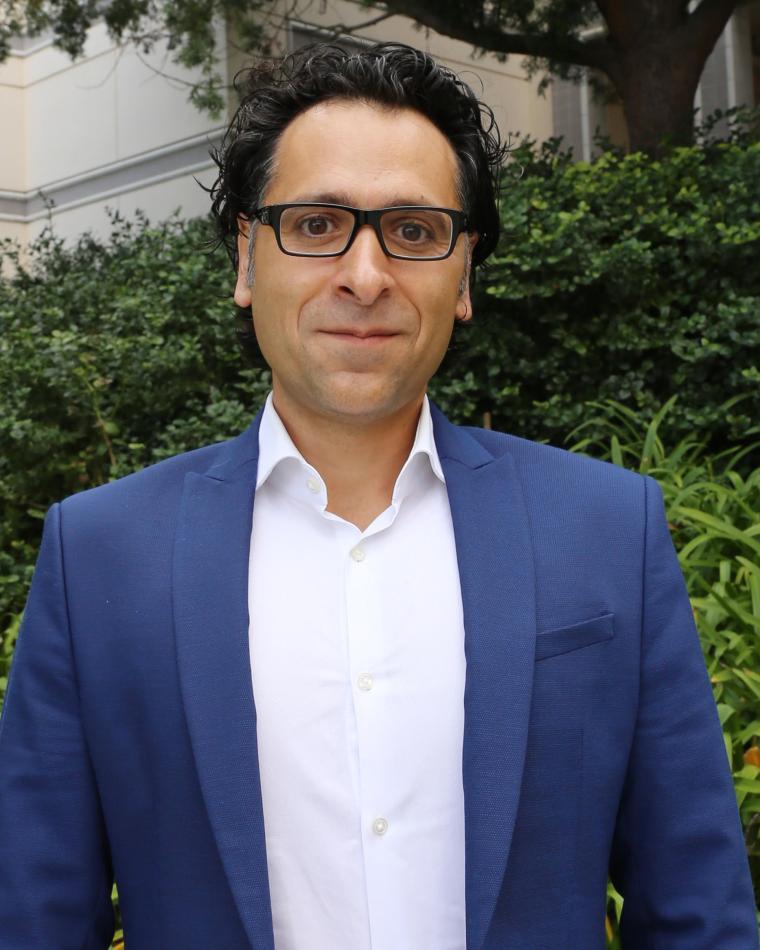
Zak Kassas
Zak Kassas
Contact Menu
Zak (Zaher) M. Kassas is the TRC Endowed Chair in Intelligent Transportation Systems and a Full Professor of Electrical & Computer Engineering at The Ohio State University. He is the Director of the Autonomous Systems Perception, Intelligence, and Navigation (ASPIN) Laboratory. He is also Director of the U.S. Department of Transportation (DOT) Center: CARMEN (Center for Automated Vehicle Research with Multimodal AssurEd Navigation), focusing on navigation resiliency and security of highly automated transportation systems.
He is an internationally recognized expert for his work in positioning, navigation, and timing (PNT) in GNSS-denied and GNSS-challenged environments by exploiting ambient terrestrial and non-terrestrial signals of opportunity (SoPs). Dr. Kassas and his team convincingly demonstrated that PNT via SoPs is eminently practical and accurate for several important use cases: aerial and ground vehicles and pedestrians in indoor environments. Dr. Kassas and his team made several breakthrough contributions that proved SoPs could be practically exploited for high-accuracy, real-world PNT. They were the first to (1) develop a cognitive opportunistic navigation framework that successfully acquired, tracked, and deciphered unknown Starlink and OneWeb low Earth orbit (LEO) satellite reference signals; (2) develop a simultaneous tracking and navigation (STAN) framework that exploited multi-constellation LEO satellite signals (Starlink, OneWeb, Orbcomm, Iridum, and NOAA) with poorly known ephemerides and demonstrated UAVs and ground vehicles navigating with this framework with meter-level accuracy; (3) develop a comprehensive approach to extract accurate PNT information from 4G long-term-evolution (LTE) and 5G signals; (4) develop a tightly-coupled SoP-aided inertial navigation system (INS) framework for robust and accurate navigation; (5) demonstrate high-altitude aircraft and unmanned aerial vehicles (UAVs) navigating at meter-level and submeter-level accuracy, respectively, exclusively with ambient cellular communications signals via sustained carrier-phase-based positioning; and (6) develop a radio simultaneous localization and mapping (radio SLAM) framework to exploit unknown transmitters and demonstrated the framework’s efficacy in a real-world GPS-jammed environment.
He received from President Biden the Presidential Early Career Award for Scientists and Engineers (PECASE), the highest honor bestowed by the U.S. government on outstanding scientists and engineers early in their careers. He is a Fellow of the IEEE, a Fellow of the Institute of Navigation (ION), and a Distinguished Lecturer of the IEEE Aerospace & Electronic Systems Society and the IEEE Intelligent Transportation Systems Society. He was ranked in 2024 by ScholarGPS as the top scholar in the world in the field of Navigation. He authored more than 210 peer-reviewed journal and conference papers, 13 magazine articles, 3 invited book chapters, and 27 U.S. patents. His awards include the National Science Foundation (NSF) CAREER award, Office of Naval Research (ONR) Young Investigator Program (YIP) award, Air Force Office of Scientific Research (AFOSR) YIP award, IEEE Walter Fried Award, ION Samuel Burka Award, ION Col. Thomas Thurlow Award, IEEE Harry Rowe Mimno Award, and IEEE Richard Kershner Award. His students have won several awards, including three Best Ph.D. Dissertation awards (from IEEE, ION, OSU); two US DOT Graduate Student of the Year awards; and 40+ best paper, student paper, and paper presentation awards.
His research has attracted more than $28 million in competitive federal grants from ONR, NSF, AFOSR, DOT, NASA, NIST, Sandia National Laboratories, the Aerospace Corporation, among others. His research was featured in dozens of national and international media outlets (Science, BBC, Forbes, IEEE, ACM, Ars Technica, MIT Technology Review, among others) and appeared on 8 magazine covers. He has given 120+ invited presentations, keynotes, and plenaries, and served as a subject matter expert to DOD, GAO, DOT, and NSF. He is a Senior Editor of IEEE Transactions on Intelligent Transportation Systems and an Associate Editor of IEEE Transactions on Aerospace and Electronic Systems, and was a Senior Editor of IEEE Transactions on Intelligent Vehicles. He was the Program Chair of IEEE/ION PLANS 2020 & 2023 and General Chair of ION Cognizant Autonomous Systems for Safety Critical Applications (CASSCA) 2018 & 2019. He was involved in organizing numerous conferences, workshops, and special sessions at IEEE/ION PLANS, IEEE VTC, ION GNSS+, ION ITM, IEEE ICASSP, IEEE ITSC, and FUSION. His research interests include navigation systems, low Earth orbit satellites, cognitive sensing and software-defined radio, intelligent transportation systems, autonomous vehicles, and cyber-physical systems.